FEATURE STORY| From One Graduate’s Initiative to Community Action: MMSU Trains Swine Raisers on Alternative Feeds
Written by Administrator on 15 September 2026
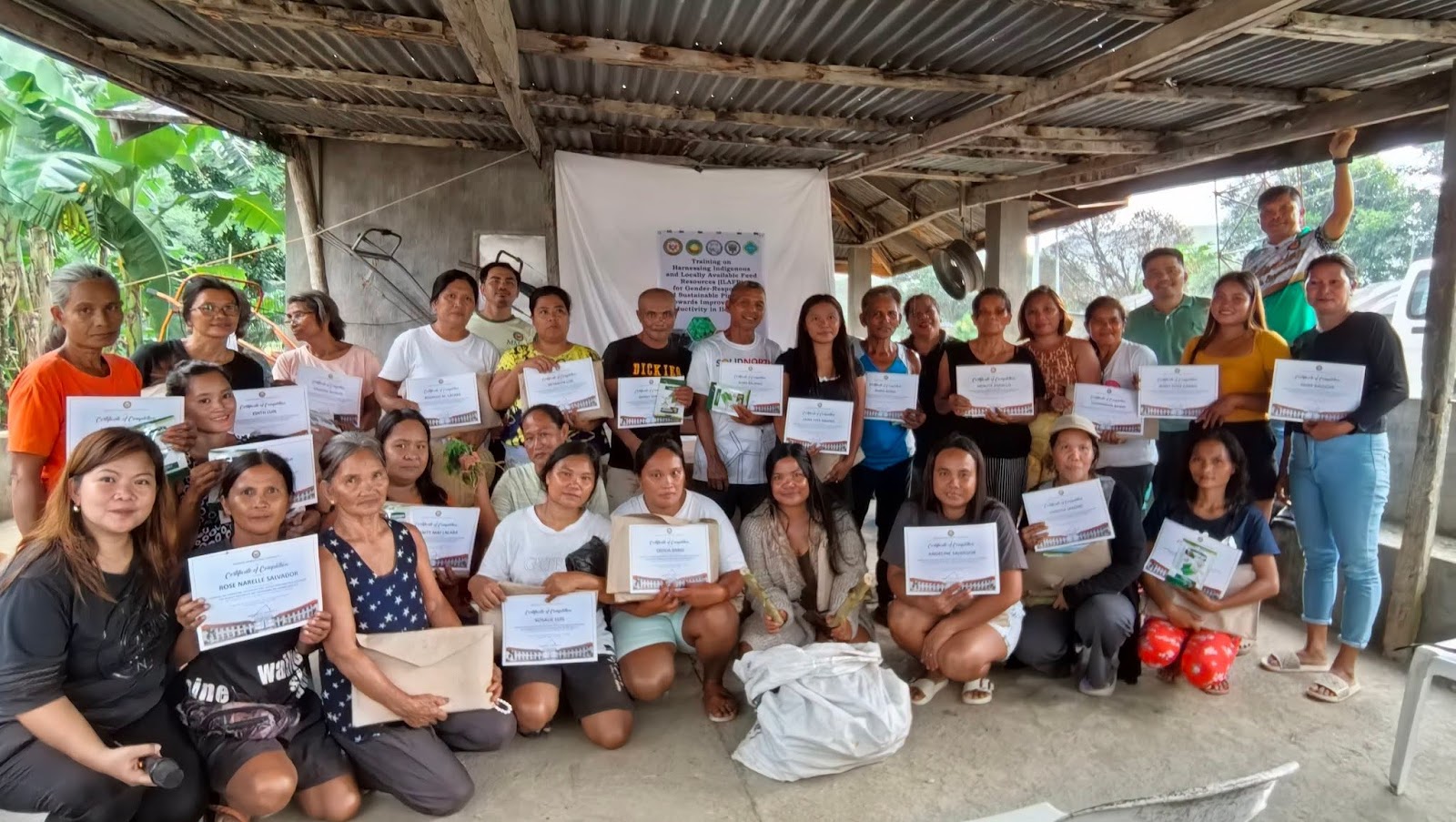
SAN MARCELINO, DINGRAS, ILOCOS NORTE — What started as a simple request from a passionate graduate and Top Achiever of the School-on-the-Air (SOA) program has grown into a community-wide initiative, bringing sustainable swine management solutions directly to smallholder farmers in Dingras, Ilocos Norte.
In response to the soaring costs of commercial feeds that threaten the livelihoods of local hog raisers, the Mariano Marcos State University (MMSU)—through its Extension Directorate and the College of Agriculture, Food and Sustainable Development (CAFSD)—conducted a training on Indigenous and Locally Available Feed Resources (ILAFR) in Barangay San Marcelino, Dingras, on September 10, 2026.
SOA graduate Ms. Evangeline Libungan initiated the training request so she could share her learning with her community in Dingras. After learning about alternative feed sources during her SOA sessions, Ms. Libungan recognized the potential impact these technologies could have on her fellow community members in an Indigenous Peoples (IP) area belonging to the Isneg tribe.
“Very much interested-ak kadidiay last topic tayo, ma’am... and napanunotak a kayat ko koma maishare kadagiti ka-sitio ak [I was very interested in our last topic, and I thought about sharing it with my site mates],” Ms. Libungan shared in her initial request to MMSU. “Dakkel a tulong dayta impormasion, kasi asideg kami iti bantay... dagita alternative feeds, ita ko lang met a naamuan [This information is a big help because we live near the mountains. I only recently learned about these alternative feeds, and I wanted them to learn how to mix feeds properly, too].”
Led by the Extension Directorate alongside CAFSD, the training equips local participants with practical skills to identify, safely process, and integrate local crops and agricultural by-products into balanced rations. Beyond cutting production costs, the program emphasizes resourcefulness, environmental sustainability, and gender-responsive livestock management, encouraging both women and men to participate in farm management and household decision-making.
Dr. Sean R. Vidad of CAFSD and Dr. Susan Aquino of the Research Directorate served as key speakers for the training.
Looking ahead, Ms. Libungan hopes to institutionalize these practices through their local association to secure long-term economic resilience.
“Diay next a plan mi koma... is maging sustainable livelihood diay panagtarakenmi iti baboy using the ILAFR with the help ti asosasyon mi [Our next plan is to make swine raising a sustainable livelihood using ILAFR with the help of our association],” Ms. Libungan explained. She noted that members rely heavily on the Madongan Dam Association, but because income from the dam is seasonal, livestock raising provides a crucial safety net. “Tapno adda nayon a pangalaan ti agserbi iti inaldaw ken nayon a pagpaadal kadagiti ubing, tapno agsto wennu ma-lessen diay cycle ti poverty [So we have a source of income to support our daily living and send our children to school, helping stop or lessen the cycle of poverty].”
Community Leaders Voice Gratitude and Commitment
The training was warmly received by local IP elders, leaders, and council members, who highlighted the value of bringing scientific knowledge directly to upland communities:
• Danny Magno (IP Chieftain): “Yamanenmi ta napiliyo ditoy lugarmi a pagtrainingan. Agyamankami iti serbisio nga inpaayyo. [We are thankful that you chose our place for this training. Thank you for the service you provided.]”
• Pedro Magno (IP Elder): “Maragsakankami ta immaykayo tapno iburay dagiti pagsayaatanmi iti sitiomi... Iyaplikartayo dagiti nasursurotayo. An-anusantayo dagiti tarakentayo. [We are glad you came to share beneficial knowledge in our sitio. To my fellow participants, let us reflect on what was taught so we can increase our income. Let us apply what we learned and take care of our livestock.]”
• Angeline Magno (Sub-Auditor, Madongan Dam Cottage Owners and IP Farmers Association): “Nanayunan ti knowledgemi nga agtaraken iti baboy... Adda gayam iti sistema iti panagpakan, saan a patpatang. Ket sapay ta dakdakkelto ti mapastrekmi. [Our knowledge in pig raising has grown. We learned that there is an actual system to feeding, not just random practice. Hopefully, this leads to higher earnings.]”
• Elmo Balbino (Sitio Leader): “Agyamankami iti inpaayyo a sursuro tapno lumag-an dagiti sistema ti panagpakan iti baboy... Dakkel a pakaekonomiaan no talaga a surutentayo. [We thank you for teaching us ways to ease our pig feeding systems. It will be a big boost to our economy if we truly follow what was taught.]”
• Rubio Bangi (Barangay Kagawad): “We are IPs. Awan ti bukodmi a talon isu a maatraskami kadagiti kapatadami. Ket agyamankami kadagiti serbisio nga ipaayyo kadakami. [We are IPs. We do not own farmland, which is why we often lag behind others. We are deeply grateful for the services you brought to our area.]”
Inter-Agency Collaboration Drives Success
By responding directly to the needs expressed by a SOA graduate, MMSU’s Extension Directorate reinforces its commitment to ensuring that practical agricultural technologies reach rural and indigenous communities—paving the way for a more resilient, inclusive, and profitable swine industry across Ilocos Norte.
The training was conducted with the assistance of LGU-Dingras through its Municipal Agriculture Office (MAO), one of MMSU’s key partners in implementing the SOA program. The recently concluded SOA on Vegetable Production on June 26, 2026, was successfully implemented by MMSU in partnership with the Ilocos Agriculture, Aquatic and Natural Resources Research and Development Consortium (ILAARRDEC), the Provincial Government of Ilocos Norte, local LGUs, and radio partners DWFB, DWNI, and DWCI.
The overall initiative also received generous support from the Department of Agriculture - Regional Field Office 1 (DA-RFO 1), DA-Ilocos Norte Research and Experiment Center (DA-INREC), Agricultural Training Institute (ATI-RTC 1), Philippine Rice Research Institute (PhilRice), National Tobacco Administration (NTA), and other institutional partners.
Requesting Community Trainings
Communities, associations, or local government units interested in conducting similar extension trainings may submit a formal request letter addressed to MMSU President Dr. Virgilio Julius P. Manzano, Jr., through Extension Director Dr. Marlowe U. Aquino.
For further inquiries and coordination, interested parties may contact Ms. Abegel Agonoy Joson, Chief of Technology Promotion and Demonstration Services (TPDS).
Other Latest News
-
Students Prepare for 9th Annual Rice Paddy Art Planting at MMSU
SEP 15, 2026
Following the reveal of the "MMSU Going ASEAN" official design last August 24, 50 Bachelor of Science in Agriculture students gathered today, September 15, for a technical orientation to prepare for the hands-on field establishment of the university's 9th annual Rice Paddy Art. Jointl... [view more]
-
Announcement: Free Training on Vermicomposting and Organic Fertilizer Production
SEP 15, 2026
Tired of expensive inorganic fertilizers?Learn how to make your own low-cost, high-nutrient organic fertilizer to cut down your farm expenses!What you will learn:• Setting up your own vermicomposting project• Turning crop waste and manure into rich compost• Simple ways to reduce your... [view more]
-
Feature Story|Fields of Red: It's Harvest Time for Pasuquin's Off-Season Tomato Farmers
SEP 14, 2026
Growing off-season tomatoes is truly challenging, but at the same time, deeply fulfilling. Despite the heavy rains that recently hit the province and other areas in the country, our project partners have successfully started harvesting tomatoes—specifically the MMSU off-season tomato variety.... [view more]
-
MMSU-CAS Implements "PanagTARIBAY iti Ili" Program to Empower Local Governance and Communities in Pinili
SEP 04, 2026
Mariano Marcos State University (MMSU), through the Department of Social Sciences (DSS) under the College of Arts and Sciences (CAS), has launched a comprehensive extension program titled “PanagTARIBAY iti Ili: Technological Assistance in Revitalizing and Initiating Boundaries towards Yielding... [view more]
-
NEWSBRIEF|MMSU-ED partners with DA-PhilRice
AUG 27, 2026
The MMSU Extension Directorate is currently completing land preparation for a 4.5-hectare rice seed production project in partnership with the Department of Agriculture – Philippine Rice Research Institute (DA-PhilRice).As an accredited seed producer, the Directorate maintains this sustained i... [view more]